Last-mile delivery accounts for up to 53% of total shipping costs, according to Capgemini Research Institute. For most Singapore sellers, that's more than packaging, warehousing, and sorting combined.
Most of your shipping budget goes to the last kilometre.
The "last mile" is the final leg of delivery, from the local hub to your customer's door. It's also the most expensive part of the supply chain.
Why? Because unlike bulk shipments between warehouses, last-mile delivery involves individual stops, unique addresses, and unpredictable variables like traffic, parking, and customer availability.
According to a 2024 Business Insider Intelligence report, last-mile delivery costs have risen by over 30% in the past five years. In Singapore's context, where 80% of the population lives in HDB flats with lift access challenges and limited parking, these costs compound further.
If you're spending $15 on a delivery and wondering where the money goes, more than half is likely consumed by that final handoff. For a broader perspective, see how Singapore's costs compare to Hong Kong, the US, and UK.
Failed deliveries cost more than you think.
A parcel that doesn't get delivered on the first attempt doesn't just delay revenue. It triggers a cascade of costs.
The delivery attempt itself still incurs a fee. Then there's the cost of customer service calls, redelivery scheduling, and potential refunds. A 2023 Loqate study estimated the average cost of a failed delivery at $17.20 per parcel globally.
In Singapore, where 5% to 10% of deliveries fail on the first attempt according to industry data, this adds up fast. For a seller shipping 100 parcels a month with a 7% failure rate, that's potentially $120 in hidden costs, not counting the damage to your seller ratings.
The main culprits? Customers not home, incorrect addresses, and missed delivery windows. Same-day delivery with confirmed time slots cuts these failures significantly.
Route inefficiency is draining your margins.
If you're shipping multiple orders daily, how those deliveries are routed matters more than you'd expect.
A driver zig-zagging across Singapore to hit five addresses wastes fuel, time, and money. According to a 2024 McKinsey report on logistics efficiency, optimised routing can reduce delivery costs by 20% to 30%.
Most traditional courier services batch your parcels with others, optimising for their network, not your orders. You pay per parcel with no visibility into how the route is planned.
Multi-stop delivery with smart routing changes this equation. When your five deliveries are planned as one optimised route, the per-stop cost drops substantially, and those savings can be passed directly to you. We cover this and three other cost-cutting tactics in how to reduce last-mile logistics costs.
Choose delivery partners who price transparently.
The Singapore delivery market ranges from budget options like Ninja Van for next-day at $3 to $5 per parcel, to premium same-day services from GrabExpress starting at $28 base plus distance fees.
But headline prices rarely tell the full story. Surcharges for CBD addresses, Tuas, Sentosa, weight tiers, and fuel levies can inflate your final bill by 40% or more.
Look for delivery services that show the final price before you book. No callbacks, no quotes, no surprises. If you're shipping multiple orders, ask about multi-stop pricing with route optimisation, where savings from efficient routing are passed to you, not absorbed by the platform.
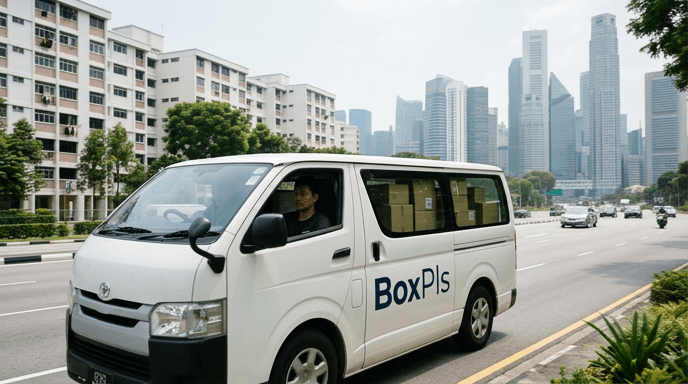
BoxPls provides half-day support from $165 and full-day support from $299, depending on your business needs. No contracts, self-serve booking, on-demand across Singapore. We run your deliveries like we are part of your business. A 5% platform service fee applies at checkout, shown before you pay. This block model arrived with the August 2026 BoxPls restructure.